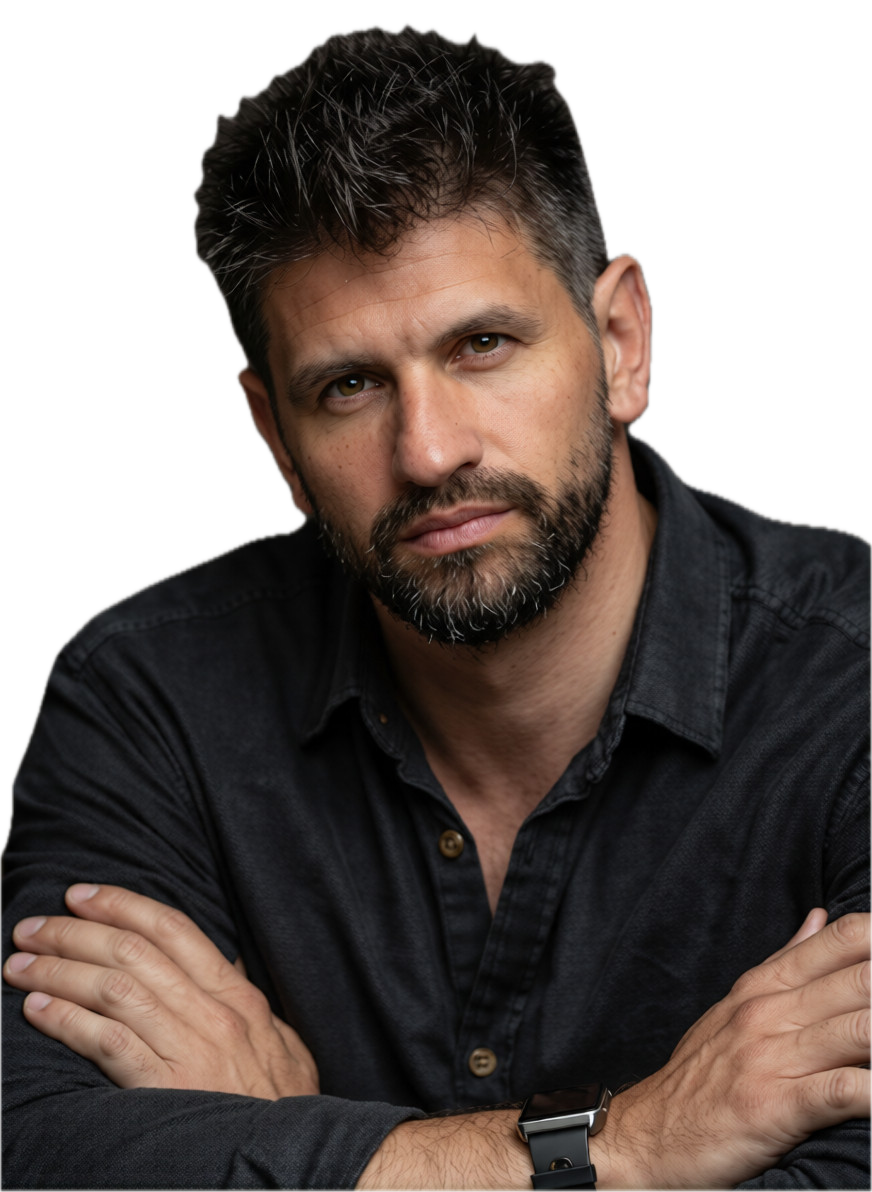
Leonid Goldberg

Business IT solutions and AI process integration

I build systems that automate operations, speed up decision-making, and improve efficiency — from architecture to production delivery.

React / Next.js
Python (Django)
PostgreSQL
Model Context Protocol (MCP)
Cursor / Claude Code
RAG / Agents
Docker
React / Next.js
Python (Django)
PostgreSQL
Model Context Protocol (MCP)

Code is engineering art

Modern web engineering requires more than functionality. I design interfaces that feel natural, remain stable under load, and scale with the business.

React & Next.js

Server Components, edge rendering, and optimized hydration. Fast initial load and sustained performance as traffic grows.

Fast. Reliable. Scalable.

UX/UI Engineering

Pixel-perfect UI with thoughtful micro-interactions. Every component is purposeful and moves users toward the goal.

ComponentLive
State
loading
ready
Render
SSR
+
Hydrate
OUTPUT
Paint
<12ms

How I work

From concept to production — structured, transparent, measurable.

Step 1

Discovery & Architecture

Clarify requirements, choose the stack, and design an architecture that scales. Clear scope, realistic timelines.

Step 2
PR approved

Build & Iterate

Sprint-based delivery with continuous feedback. You see progress on staging, approve iterations, and steer priorities.

Step 3
Build: OK
Tests: 100%

Deploy & Support

Production-grade release with CI/CD, monitoring, and documentation. A stable launch and maintainable operations.

Full-stack integration

React/Next.js on the frontend, Django or Node.js on the backend, PostgreSQL for data, Docker for delivery — designed as a single architecture.

The result is a unified system: low-latency APIs, consistent UX, and infrastructure that scales with demand.

FrontendBackend

System synchronized

2ms

Database and cache updated

App Router node
Persistence layer
PostgreSQL + Redis
READY

Core competencies

Full-stack engineering with a product mindset and technical leadership. I design scalable systems, automate processes, and own quality end-to-end.

Full-stack architecture

I build complex web products from scratch: strict domain typing in TypeScript, SSR/ISR for SEO, and optimized databases and caching.

Frontend
Next.js, React, Tailwind
Backend
Python/Django, Node.js
Data
PostgreSQL, Redis
Core focus

AI integrations & MCP

I integrate LLMs (GPT-4, Claude) into real workflows: assistants, analytics, automation — with safe data access via MCP.

MCP architecture
Host (LLM)
MCP server
call_tool("query_db")
read_resource("api/docs")

Capabilities

RAG pipelines and vector search
Function calling and tool access
Guardrails and AI safety

Automation

I orchestrate workflows using scripts, webhooks, and Python. I connect CRMs, messengers, databases, and document generation.

WebhooksCronData parsing
cursor_agent.py — MCP scenario
import mcp_server
from ai_engine import CursorAgent

# Safely connect internal tools via MCP
client = mcp_server.connect(transport="stdio")

async def refactor_codebase(context):
plan = await client.tools.call(
"analyze_dependencies",
{ "path": "./src/legacy" }
)
return CursorAgent.apply_diff(plan)

➜ Terminal _
AI-NATIVE ENGINEERING

AI-augmented development

I build an AI-native workflow with agents. I use Cursor, Claude, and Gemini CLI to speed up routine work, refactoring, and testing.

  • MCP standards: Connect databases and APIs as tools for LLMs right inside the IDE.
  • Rapid prototyping: From idea to working prototype in hours, not days.
  • Quality control: AI-assisted code review and automated unit test generation.

Impact & infrastructure

Technical leadership focused on business outcomes. I build systems that scale and deliver ROI.

System architectureENGINEERING

Scale blueprint

Challenge
Designing and delivering a unified ecosystem: consolidating fragmented services into a high-performance platform with robust access control and modular APIs.
Impact
Reduced operational fragmentation by 40%, improved data consistency, and created a foundation for faster releases and scaling.
Next.js 15Django 5PostgreSQLMicroservices
Unified data core
Zero-downtime migration
> status: initializing system_core> syncing service_mesh...> api_latency: 14ms> status: healthy
AI operationsAUTOMATION

Intelligent workflow

Challenge
Deploying private LLMs and agents. Building RAG systems that connect unstructured data to actions in CRM/ERP and internal tools.
Impact
Automated 70% of document processing and lead qualification, reducing response time to incoming requests by 2.5×.
LangChainOpenAI / ClaudeVector DBIntegrations
Private data guardrails
Workflow orchestration
> agent: lead_qualification_active> context: parsing incoming_data> match_found: high_value_lead> action: crm_entry_created
Quality assuranceLEADERSHIP

Stability protocol

Challenge
Refactoring legacy codebases and establishing a modern SDLC: testing, CI/CD pipelines, and observability.
Impact
Lowered failed releases to <1% and increased delivery speed by paying down technical debt and automating QA.
CI / CDUnit / E2E testingObservabilityDevOps
Predictable releases
Higher velocity
> build: success> tests: 100% passed> coverage: 94.2%> deployment: production_ready

FAQ & work format

Do you work as an engineer or a product manager?
Both: I own architecture, UX, and metrics, deliver end-to-end implementation, and focus on measurable outcomes.
What is MCP and why does it matter?
Model Context Protocol (MCP) is a standard for safe data/tool access for LLMs. It reduces hallucinations and turns AI into a reliable part of real workflows.
How do you keep data safe when using AI?
Enterprise approach: local processing where possible, PII masking, strict access control, guardrails, and auditing of model/tool calls.

Ready to improve your product and operations
I will show where tech brings fast impact.

I audit architecture, build automation, and integrate AI with security, metrics, and ROI in mind.